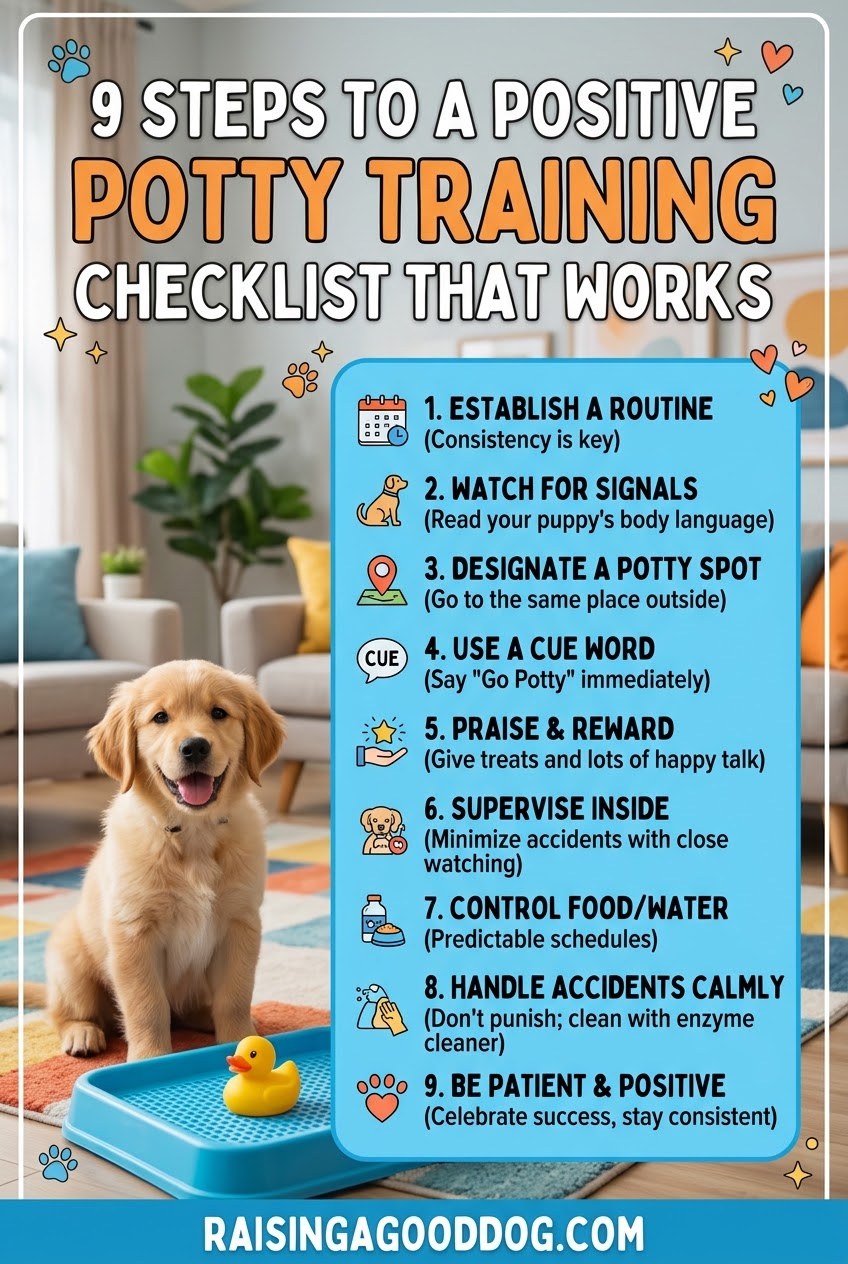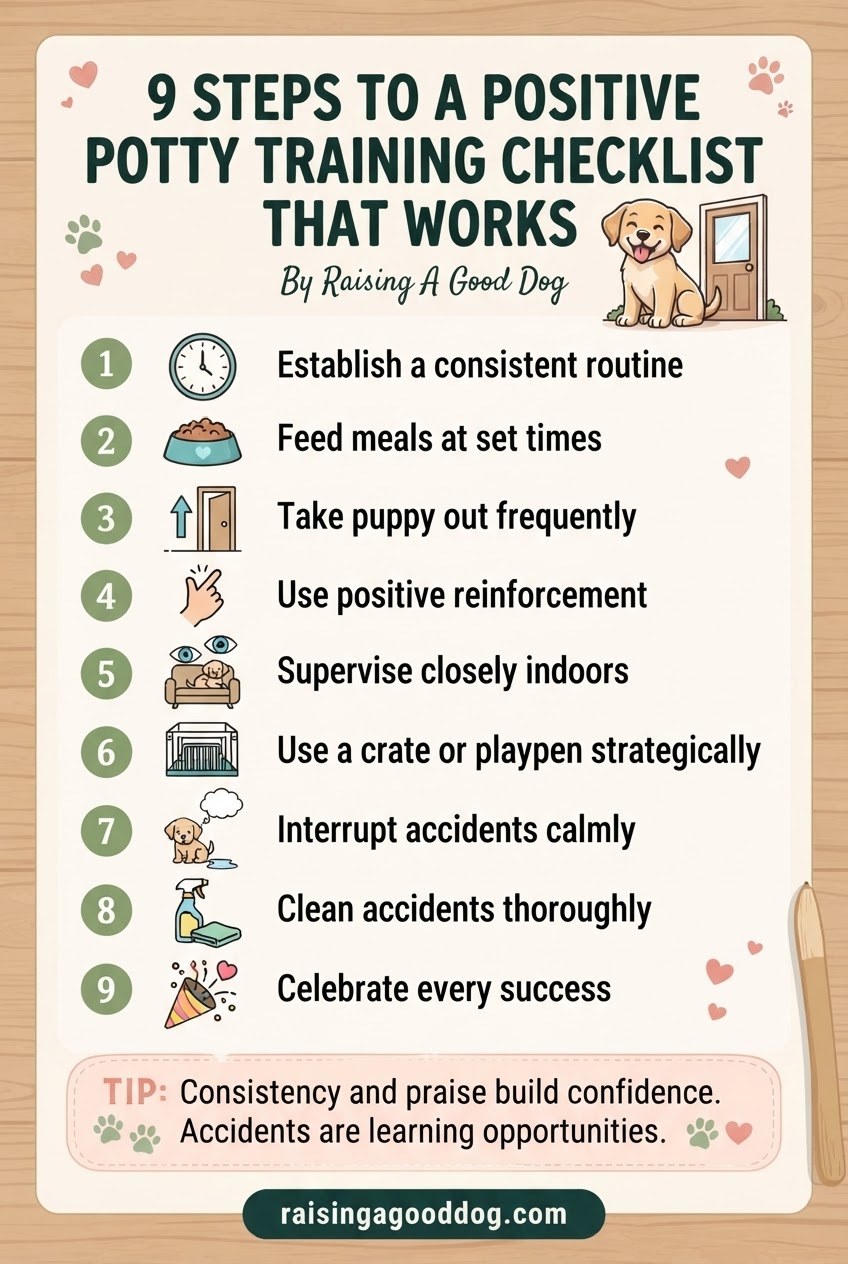
I've handed some version of this checklist to more exhausted new puppy owners than I can count, usually around week two, usually while they're holding a roll of paper towels and looking like they haven't slept. Potty training isn't complicated, but it's relentless, and most of the frustration I see in my inbox comes from missing one small piece rather than doing the whole thing wrong. Here's the full sequence, broken into the nine pieces that actually matter, in the order I teach them.
The Whole Checklist, at a Glance
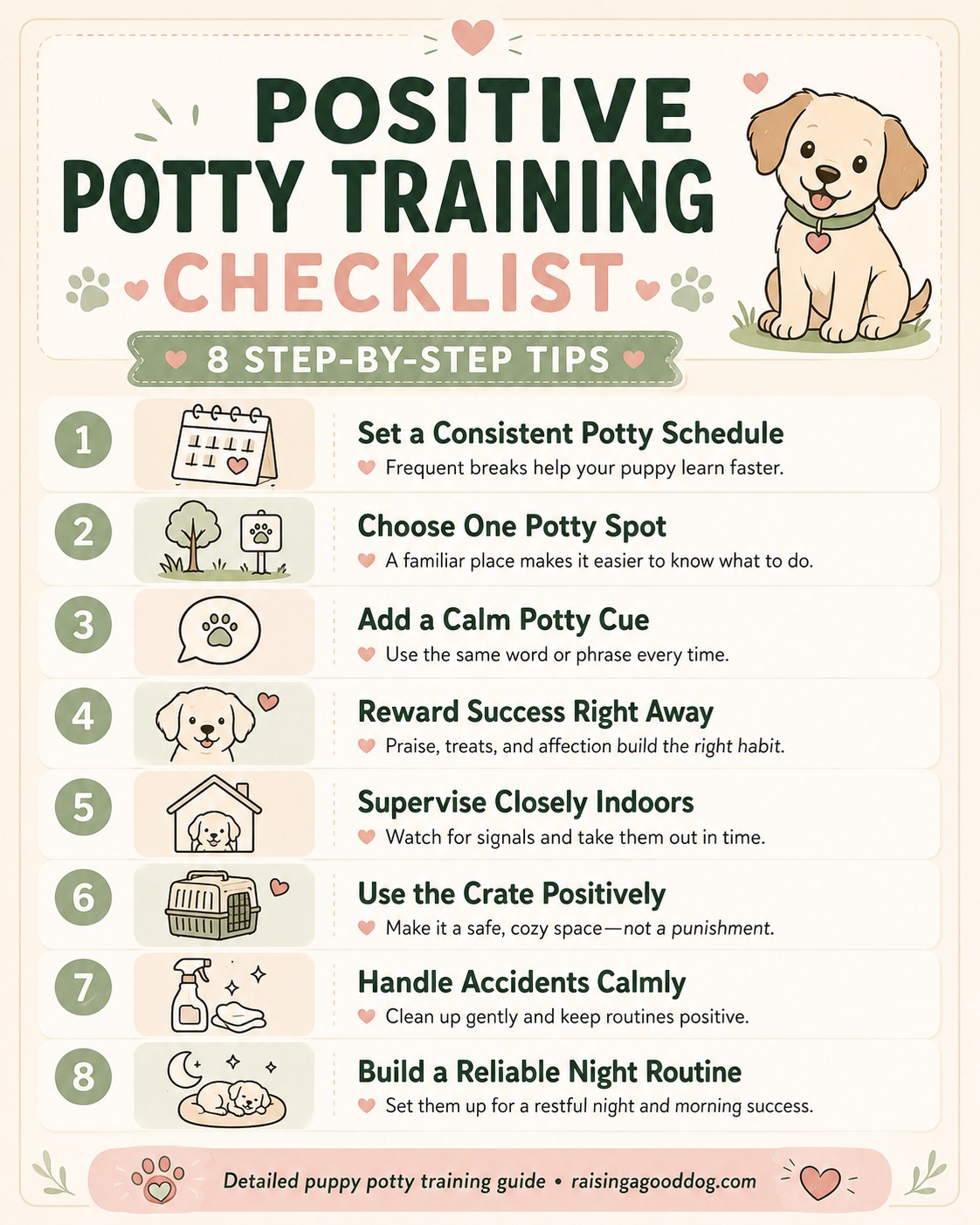
Before I break this down step by step, here's the shape of the thing. Positive potty training isn't one trick, it's eight habits stacked in order — a schedule, a spot, a cue, a reward, supervision, a crate, a calm response to accidents, and a night routine that doesn't fall apart at 3 a.m.
- It's sequential. Skipping step one and going straight to the cue is the most common mistake I see.
- It's boring on purpose. The quiet, repetitive parts are what build the habit — not the clever parts.
- It's forgiving. A setback in week three doesn't mean you've broken the plan.
I've watched enough house-training regressions get blamed on a dog being stubborn when the real issue was an owner who'd jumped to step six without ever nailing step one. Start at the top.
Step 1 — Set a Consistent Potty Schedule
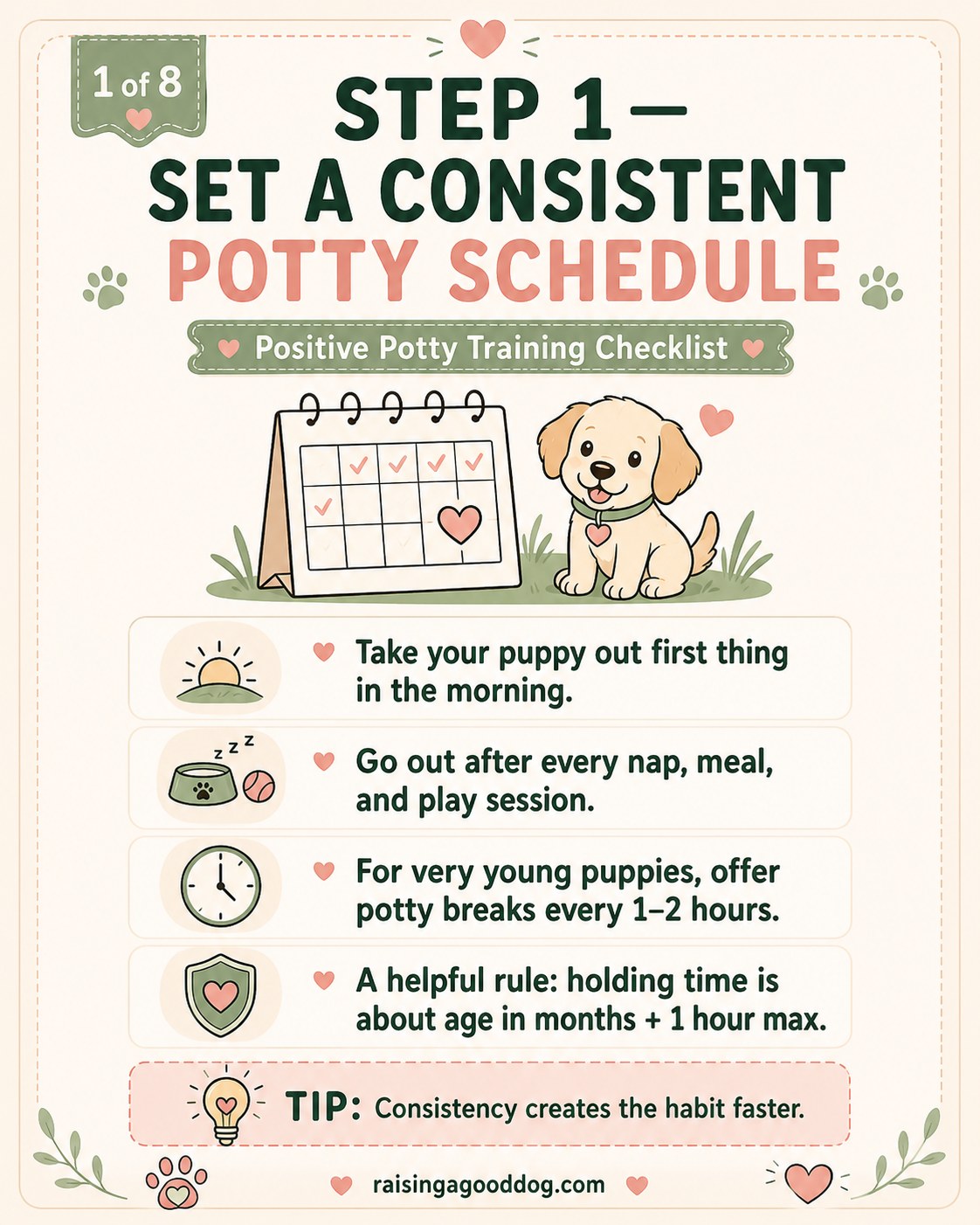
This is the step that carries the whole plan, and it's the one people rush. A puppy's bladder has a physical limit, and consistency beats intuition every time here.
- First thing in the morning: before coffee, before anything, straight outside.
- After every nap, meal, and play session: these three moments reliably trigger the urge.
- Every 1–2 hours for very young puppies: their control is genuinely that limited.
- The rule of thumb I use with clients: holding time is roughly age in months plus one hour, max.
I've had clients try to stretch this for convenience — one more meeting, one more errand — and it almost always shows up as an accident that looks like defiance but is really just biology losing a fair fight.
Step 2 — Choose One Potty Spot
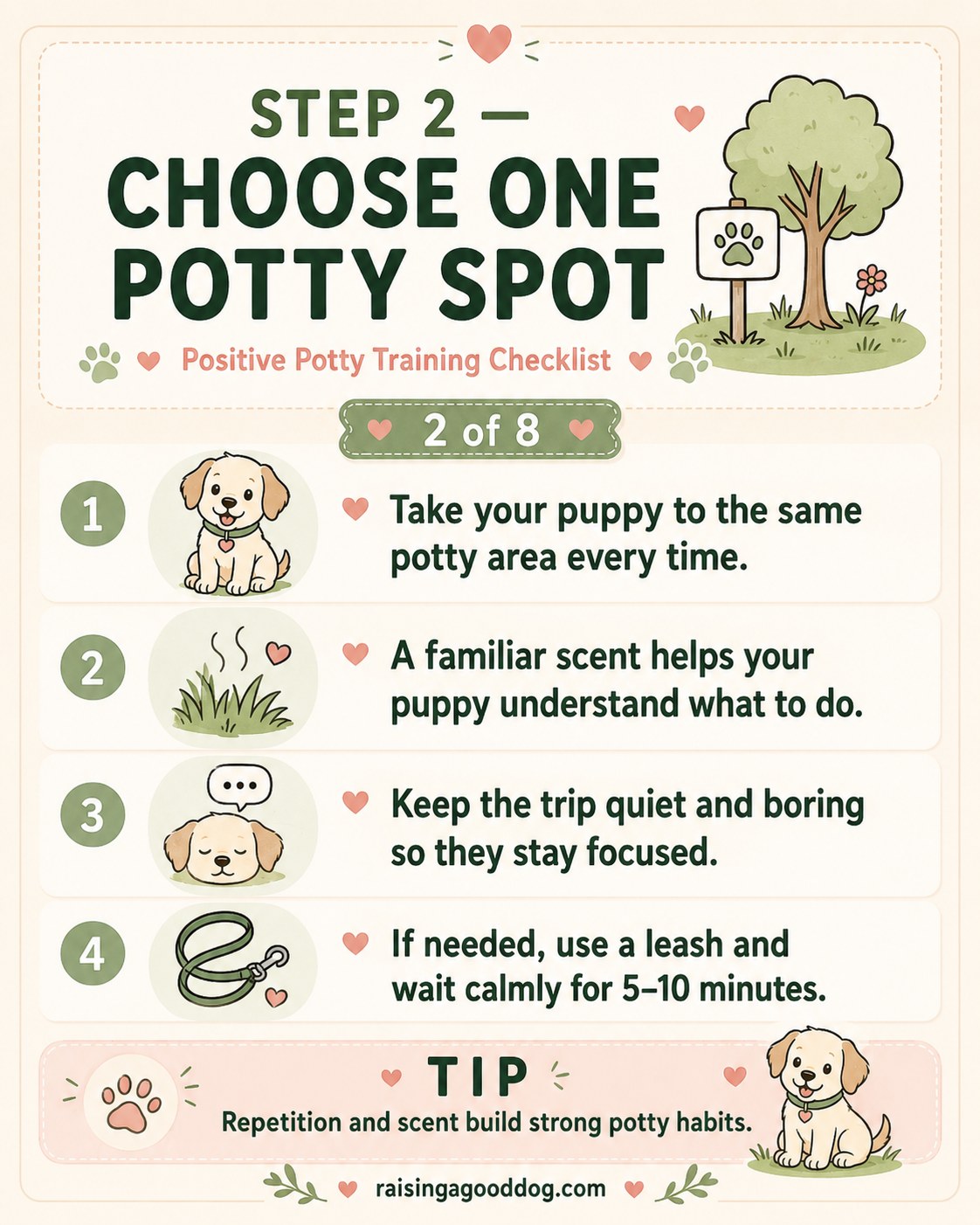
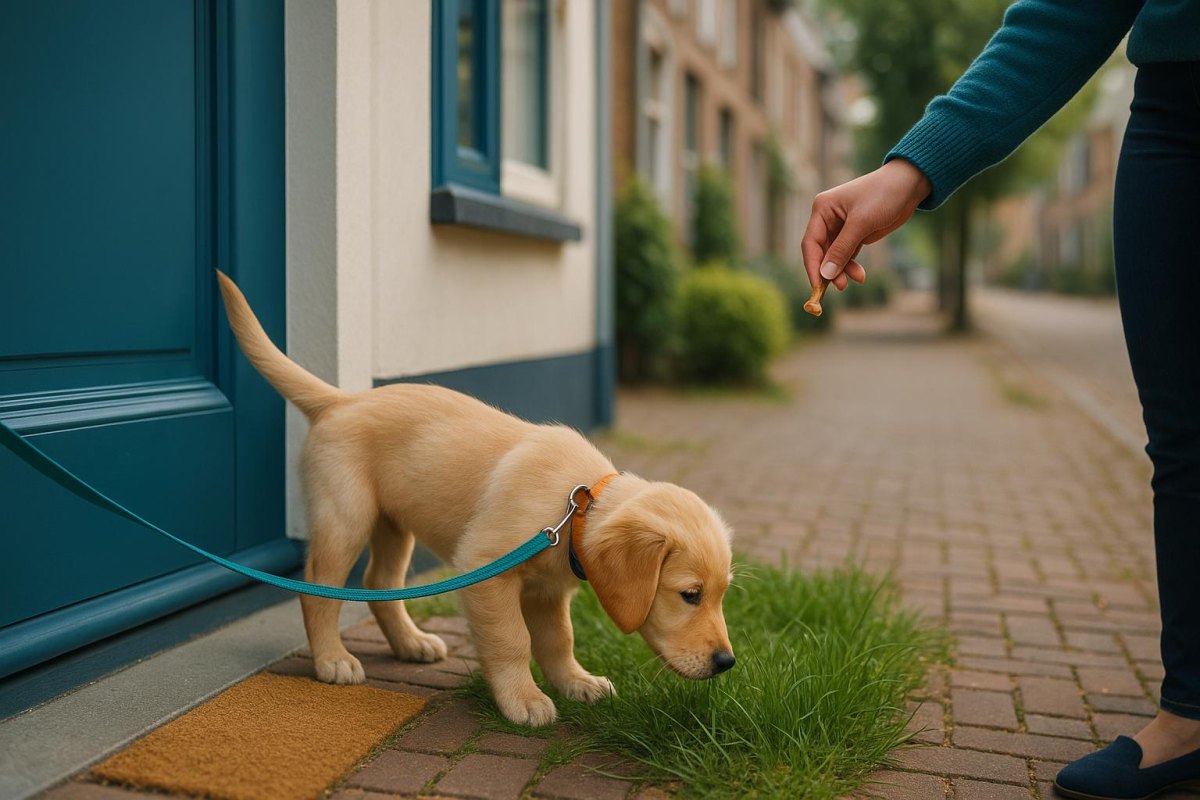
Dogs learn by association faster than we give them credit for, and a dedicated potty spot builds its own cue through scent long before your puppy understands a word you say.
- Take your puppy to the exact same patch every time, no wandering the yard first.
- Let the lingering scent do part of the teaching — it tells them what this place is for.
- Keep the trip quiet and a little boring; save the excitement for after.
- If needed, leash them there and simply wait five to ten calm minutes.
The dogs who struggle most with this step are usually the ones getting a full backyard tour before anyone asks them to focus. Boring works.
Step 3 — Add a Calm Potty Cue
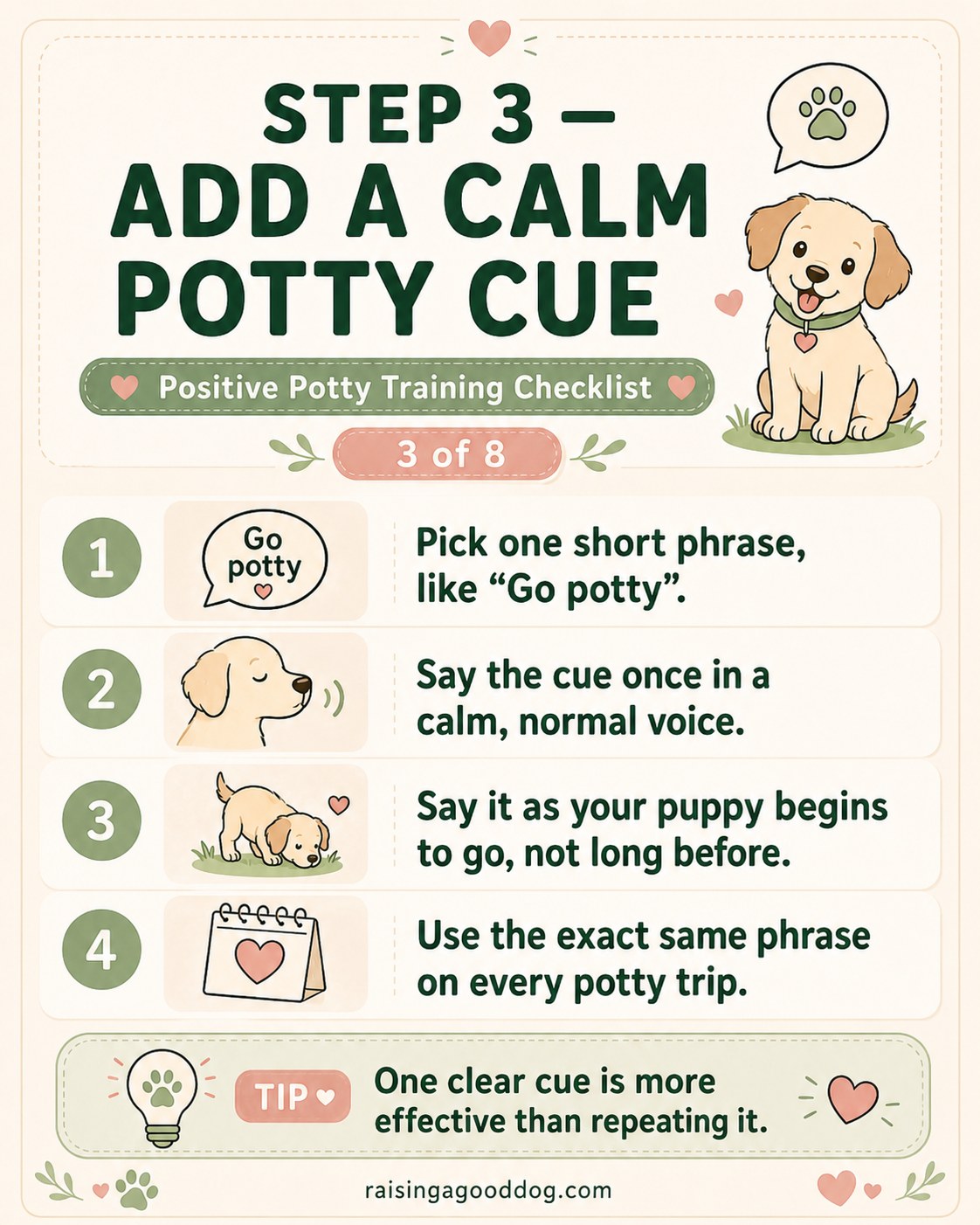
A verbal cue is a nice bonus, not a requirement, and it only works if it's introduced correctly. Say it once, calmly, right as the behaviour is already starting — not before, and not repeated five times like a countdown.
Pick one short phrase — go potty works fine, though I've had clients use everything from hurry up to get busy — and use that exact phrase, every single trip, no variation. The timing matters more than the words: say it too early and you're just narrating a walk to the grass; say it as they squat and you're actually pairing language with action.
One clear cue said once teaches faster than the same cue said nervously in a loop, which is a habit I see a lot of well-meaning owners fall into.
Step 4 — Reward Success Right Away
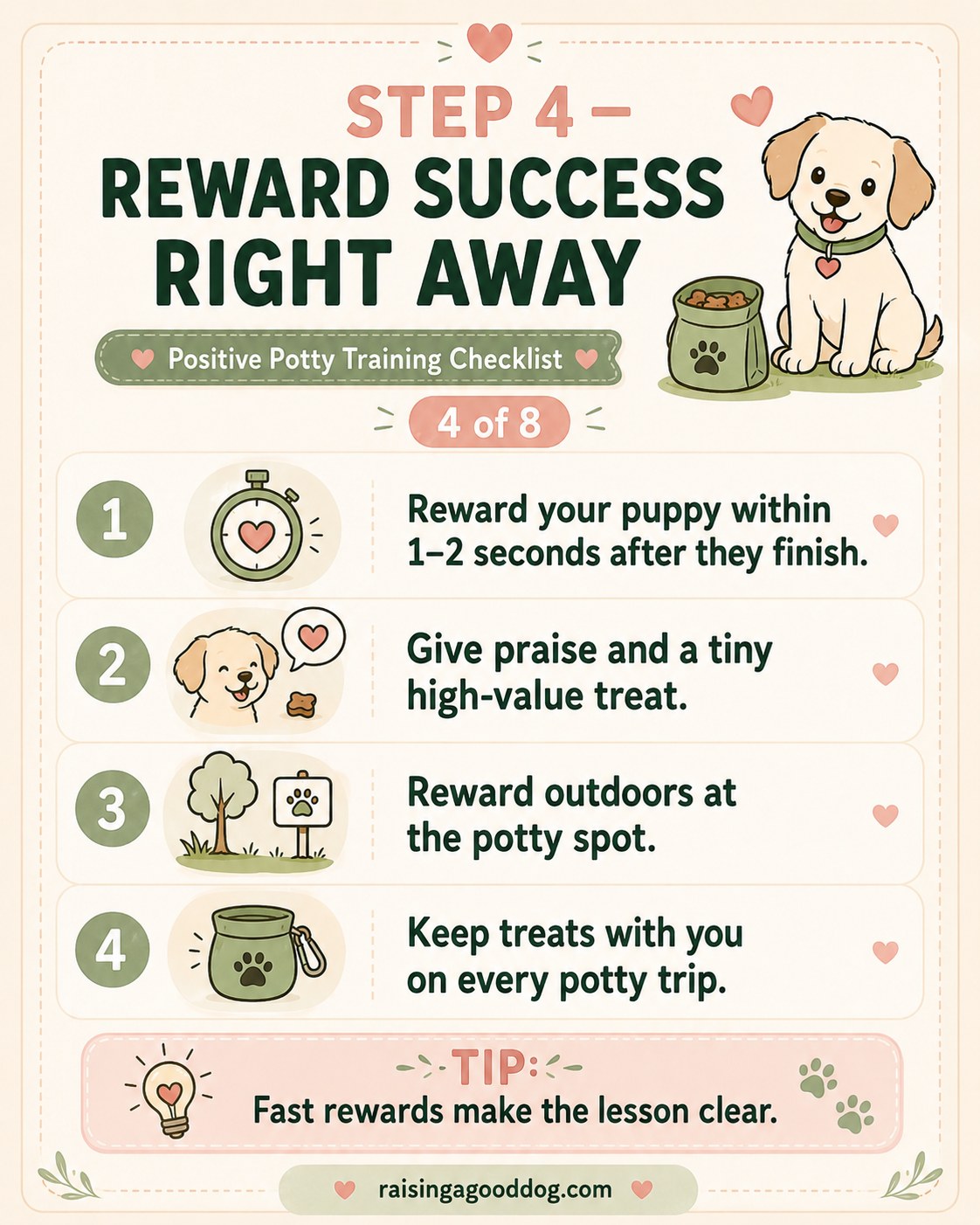
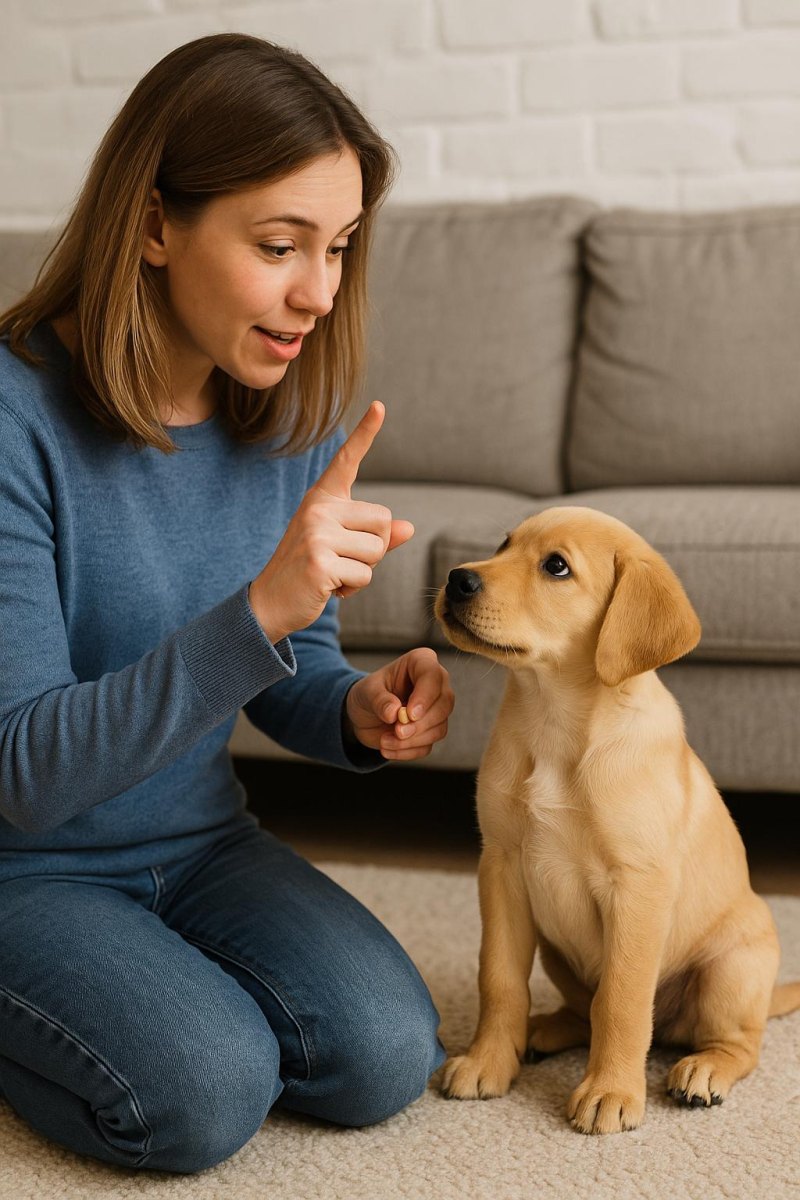
Timing is everything in this step, and it's the one place I'll actually push back on a client's instinct. You have one to two seconds after your puppy finishes for the reward to connect to the act — after that, you're rewarding whatever they're doing next, which is usually sniffing the fence.
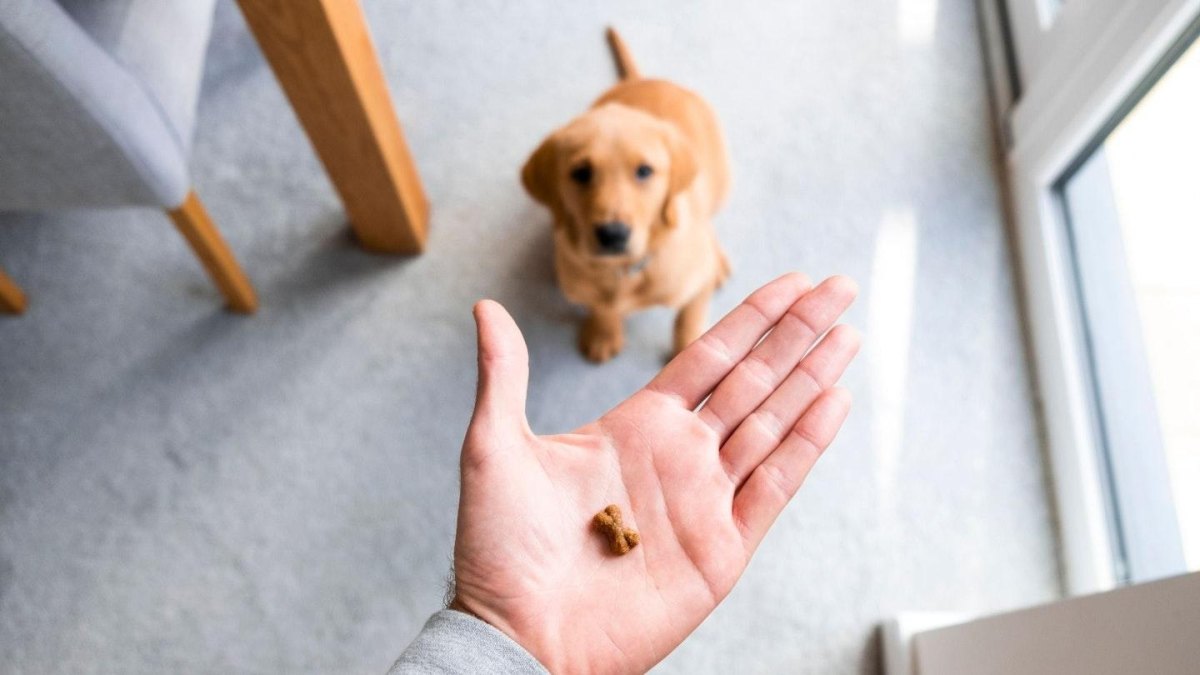
- Praise plus a tiny high-value treat — something they don't get anywhere else.
- Deliver it right at the potty spot, not back at the door.
- Carry treats on every trip, even the ones you're sure will be quick and boring.
I still see people walk back inside before rewarding, then wonder why progress stalls. That gap is the whole problem.
Step 5 — Supervise Closely Indoors
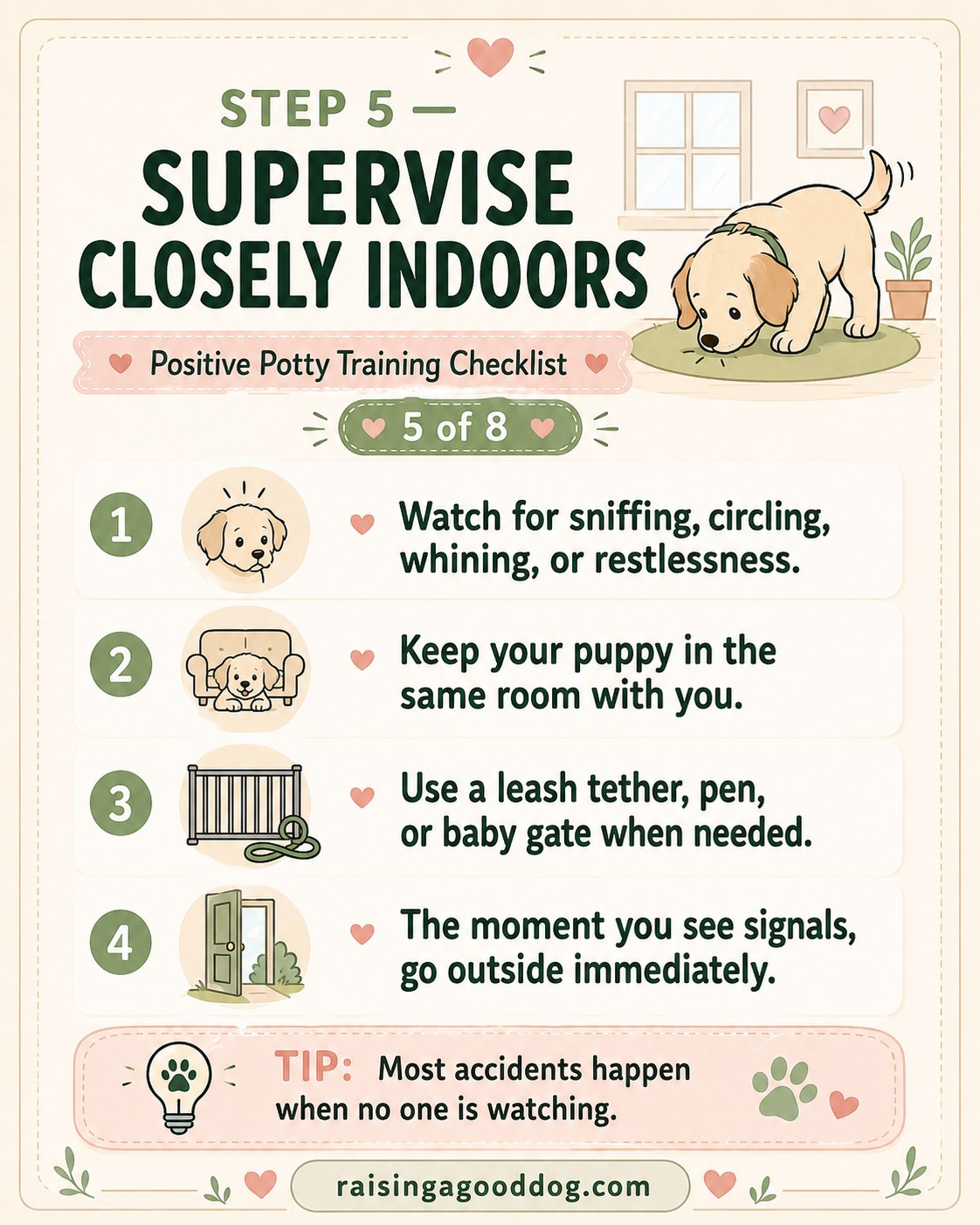
This is where my vet-clinic years show up in my training practice — I spent six years learning to read a dog's body before it did anything, and it's the single most useful skill in this entire checklist. Most accidents happen when no one is watching, not when a puppy is defying anyone.
- Sniffing the floor in tight, deliberate circles.
- Sudden restlessness or whining after being settled a moment ago.
- Wandering toward a doorway or out of the room — puppies instinctively seek privacy.
Keep your puppy in the same room as you, and use a leash tether, pen, or baby gate when you can't watch directly. The second you see any of those signals, outside, immediately, no debate.
Step 6 — Use the Crate Positively
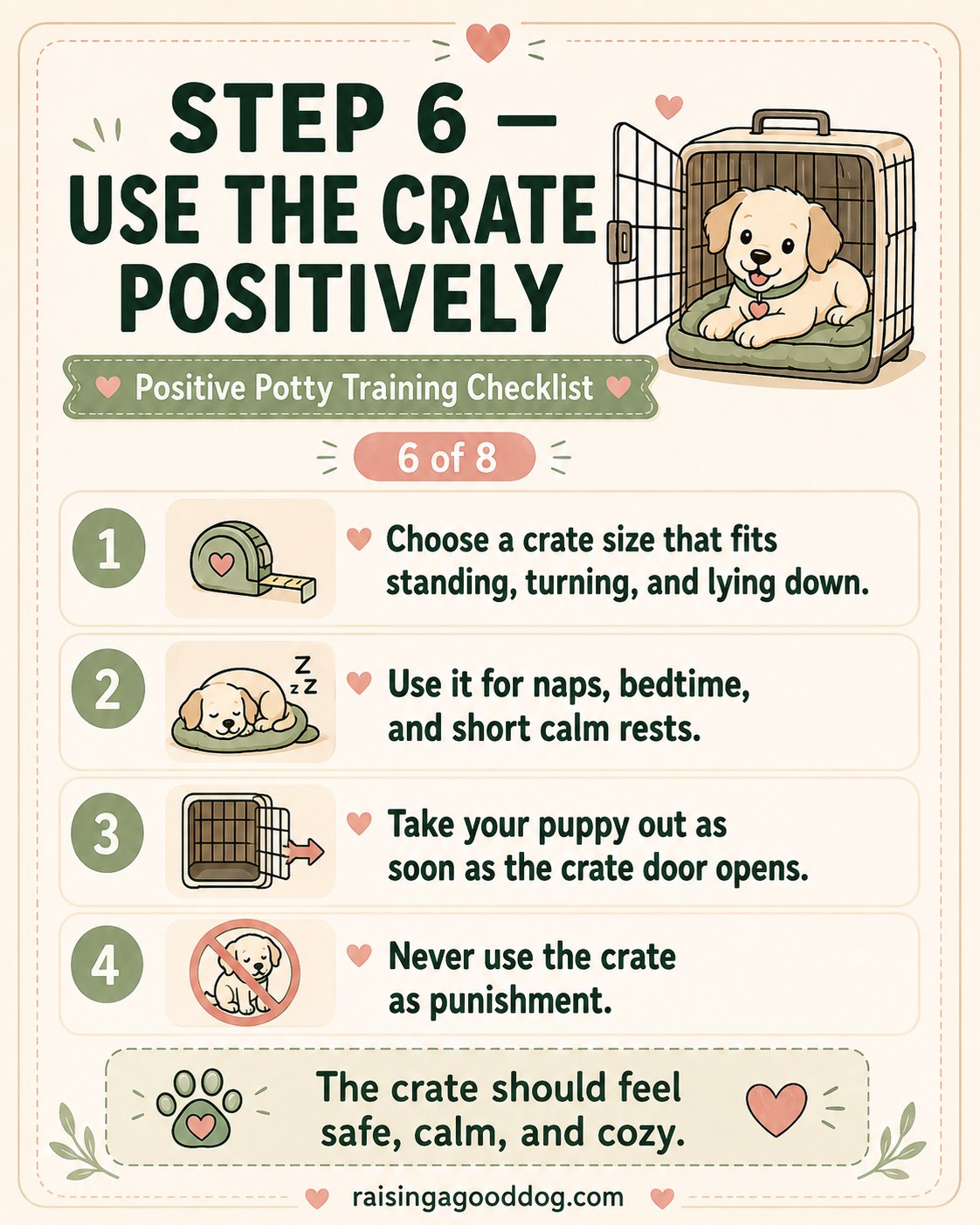
I teach crate training as optional, but for potty training specifically it's genuinely useful — dogs generally won't soil a space that feels like their own den, which is exactly why the crate has to stay a good place, not a consequence.
- Size it correctly: big enough to stand, turn, and lie down — no more.
- Use it for naps, bedtime, and short calm rests, not as a place they get sent when you're annoyed.
- Take them straight outside the moment the door opens, every time, without exception.
- Never use it as punishment — a crate that predicts scolding stops working as a den.
If your dog panics, drools, or claws at the door in a crate, that's information, not stubbornness, and it means we need a different setup before we push further.
Step 7 — Handle Accidents Calmly
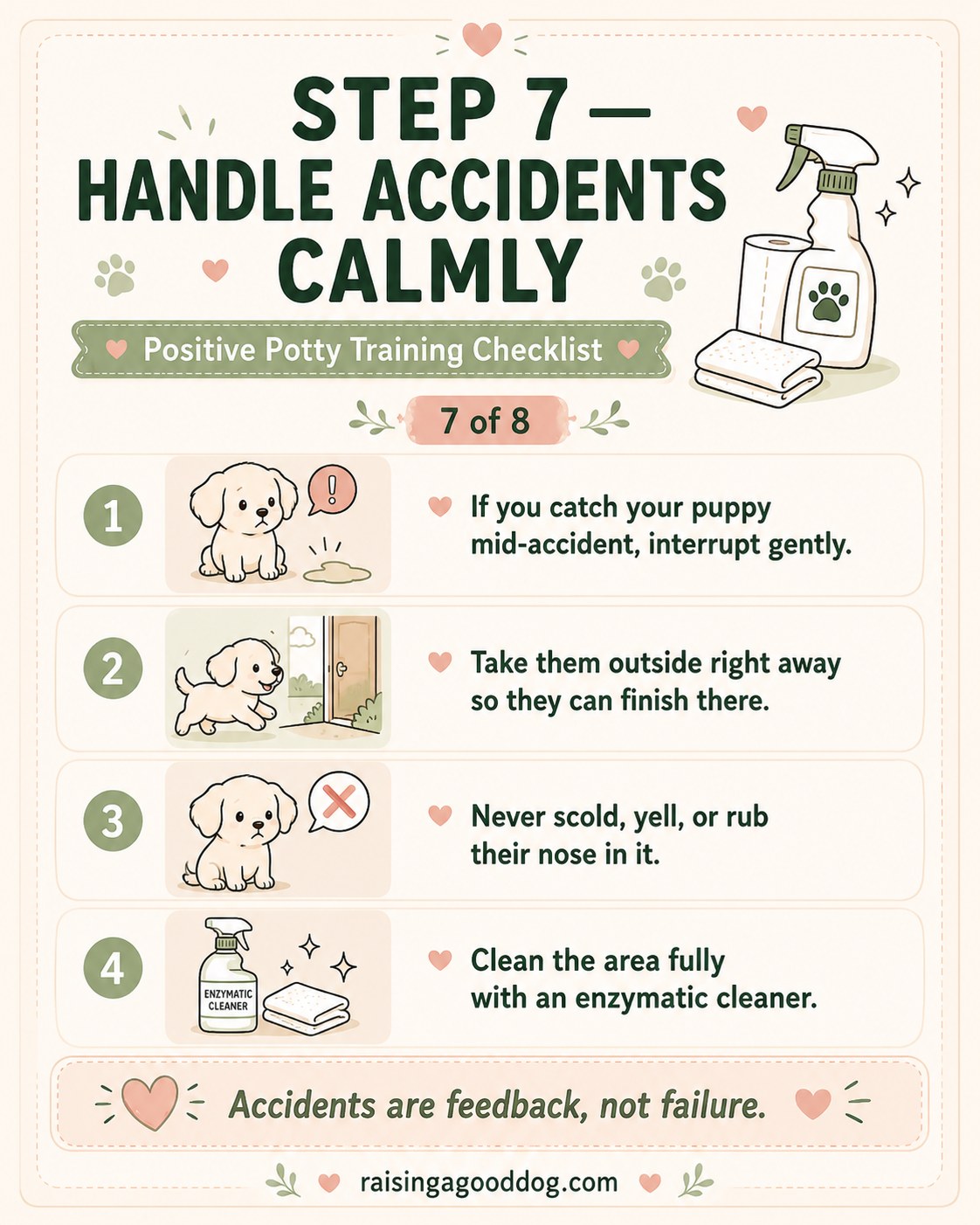
Accidents will happen — that's not a failure of the plan, it's part of it. How you respond in the next thirty seconds either protects your progress or quietly sabotages it.
- If you catch it mid-accident, interrupt gently — a light sound, not a shout.
- Get them outside immediately so they can finish where it counts.
- Never scold, yell, or rub their nose in it — this teaches fear of eliminating in front of you, which makes house-training harder, not easier.
- Clean the spot fully with an enzymatic cleaner, because dogs will return to a spot that still smells like a bathroom to them.
I've watched more house-training relapses come from a scared, secretive dog than from an untrained one. Calm cleanup is the whole strategy here.
Step 8 — Build a Reliable Night Routine
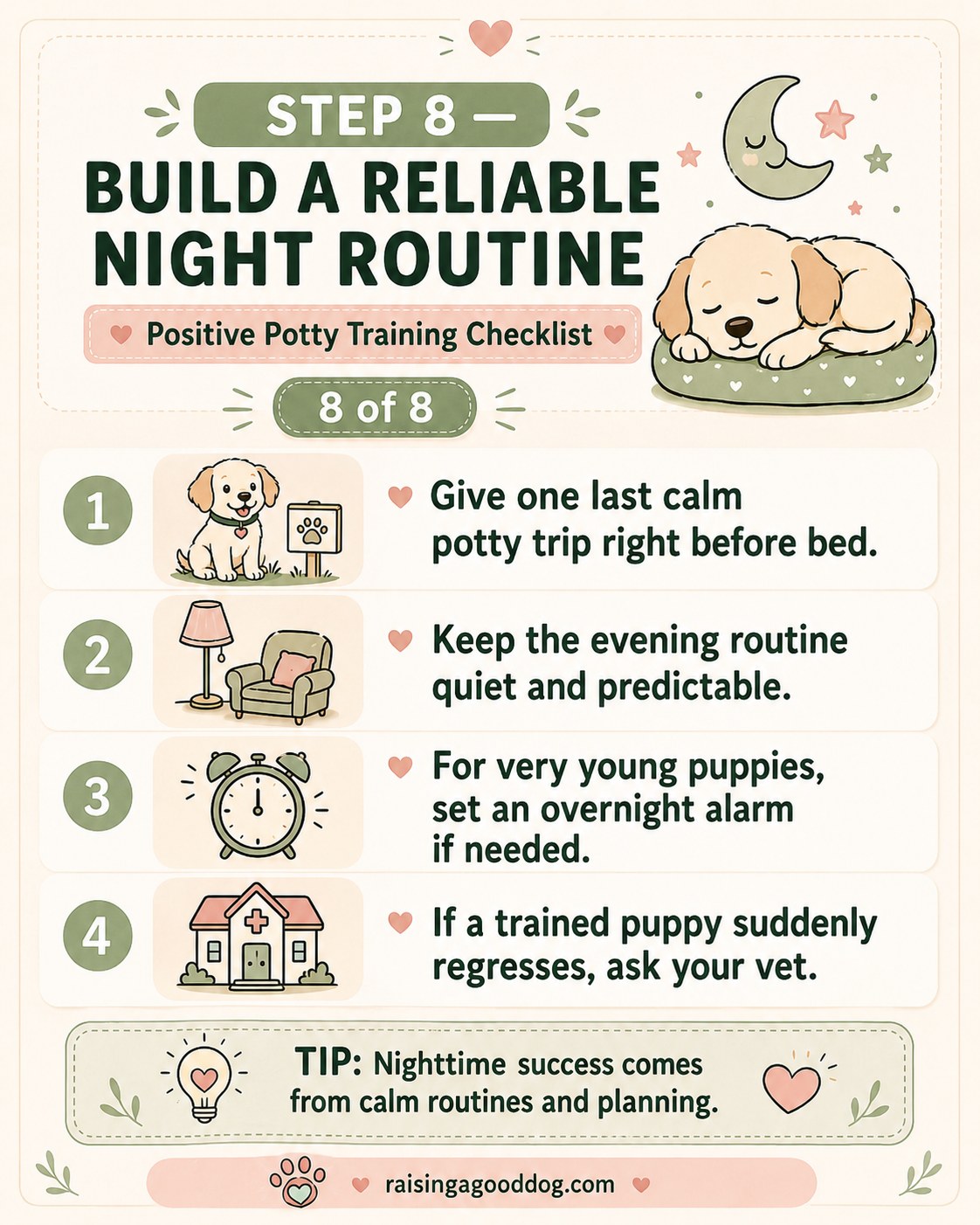
Nighttime is where consistency pays off or falls apart, and it's worth setting up deliberately rather than hoping for the best. One calm, quiet last potty trip right before bed sets the tone — keep the whole evening routine predictable rather than exciting.
- Set an overnight alarm for very young puppies whose bladders simply can't make it eight hours yet.
- Keep the routine low-key — this isn't the time for a play session.
- If a fully trained puppy suddenly starts having nighttime accidents again, call your vet before assuming it's behavioural. Sudden regressions in a previously reliable dog are one of the clearest signals that something medical — a UTI, for instance — needs ruling out first.
That last point is one I mean without exception. I'm not a veterinarian, and a sudden change like that deserves an exam, not another round of the checklist.
None of these eight steps are glamorous, and that's rather the point — the boring, repetitive parts are what actually build the habit. Go in order, expect a few accidents along the way, and if something suddenly changes that a checklist can't explain, that's your vet's job, not mine.

Your Questions, Answered
How long does positive potty training actually take?
Most puppies are reliably signalling by four to six months with consistent supervision, though full reliability — including with visitors and new environments — often takes closer to a year. Setbacks around adolescence are common and don't mean the plan failed.
My puppy potties inside within minutes of coming back from a successful trip outside. What's happening?
Usually this means the outdoor trip wasn't fully finished, or the schedule step is being stretched too far between breaks. Shorten the interval and double-check the reward is landing within one to two seconds so the outdoor trip is genuinely complete before you head back in.
Should I punish my puppy for accidents to speed things up?
No — scolding or nose-rubbing doesn't speed up house-training, it teaches a puppy to hide from you when they need to go, which makes accidents harder to catch and manage, not easier.
My puppy was fully potty trained and suddenly started having accidents again. Is this normal?
A sudden regression in a previously reliable dog is one of the clearer signs that something medical may be going on, so this is a vet visit before a training conversation, not after.